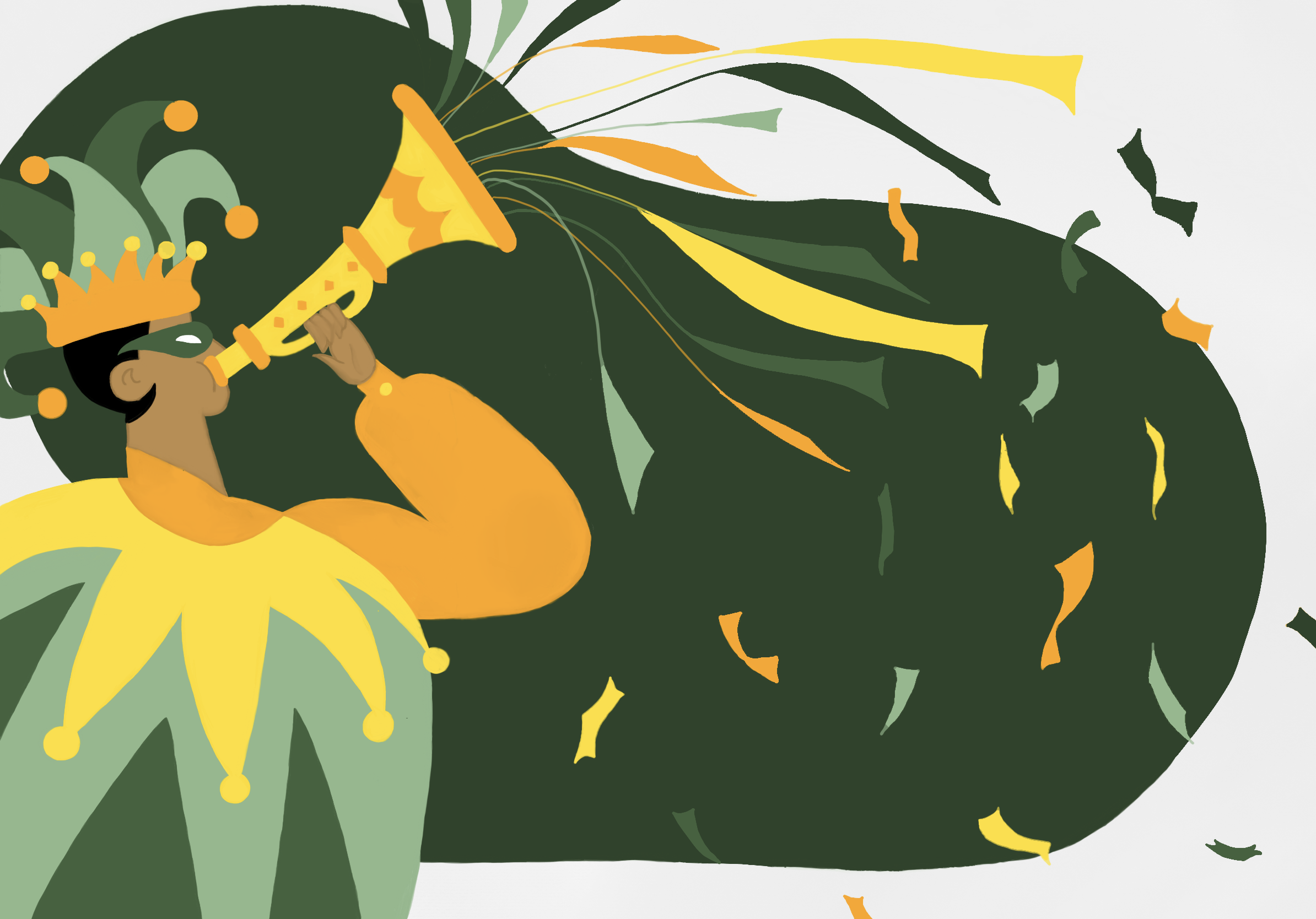
By mid-February, we are all probably quite fed up with the bad weather and the cold. But there is no need to panic, for our ancestors felt the same way. So we bid farewell to winter and started welcoming spring with Farsang (the traditional Carnival season in Hungary) and Busójárás (meaning “Busó-walking,” a local celebration in Mohács). Let us take a closer look at what these festivals are all about and how we celebrate them today!
Farsang is a long celebration, originally lasting from Epiphany to Shrove Tuesday, which lasts from 6th January to 17th February this year. Traditionally, Farsang is a festival of dances and merry feasts. What makes it special is that this celebration is in itself a folk tradition and not linked to any religious celebrations.
The name originates from a Bavarian word. The first written record of the celebration dates back to 1283, where it is mentioned as Fasnacht. However, the celebration is much older, dating back to the ancient Greeks, as it was a celebration of Dionysus, the god of wine-making and festivity. In his honour, people dressed up and wore unique masks.
In Hungary, this celebration was also a time for choosing a partner and was called the “marriage season,” as young girls sought their partners at these dances. It was also a period of welcoming spring: according to tradition, a straw doll, symbolising the evilness of winter, was burnt in order to get rid of the season.
In terms of food, fatty and spicy meat dishes were mainly consumed at these festivals, as Farsang is followed by Lent, when meat dishes were excluded from the diet. Thus, typical dishes were aspic, stuffed cabbage, duck roasted with cognac, and Carnival doughnuts (farsangi fánk).
Nowadays, Farsang is aligned with working conditions: there is no exact date, but Hungarians usually celebrate it in early February. This mainly involves wearing Carnival masks and costumes and making Carnival doughnuts.
The origins of Busójárás can be traced back to the Ottomans in the eighteenth century. According to legend, the Šokci people (a South Slavic ethnic group native to the region) fled from the Ottoman army to the nearby marshes, dressed in sheepskins and painted their faces with blood. Then, in the middle of the night, they attacked the Ottomans and drove them away. There is little truth in this legend, but still, many believe that the Busós drove away winter.
The costumes of the Busós have not changed in three hundred years and their clothing is quite distinctive: they wear fur coats turned inside out and white trousers stuffed with straw. They carry rattles in their hands and wear unforgettable masks on their heads, carved from willow wood and painted with animal blood.
In addition to the Busós, the Jankeles are worth mentioning as well. They are also people dressed in costumes: their clothing consists of rags, and they carry a bag containing rags and sawdust. Their job is to keep spectators away from the Busós: they hit spectators with their bags who venture too close to them.
Nowadays, the event takes place as follows: first, the Busós cross the Danube river together and then meet at Koló Square in Mohács. After that, they march through the town and arrive at the main square, where the festival begins. Here, they celebrate the end of winter and welcome spring with loud noises. Then, at sunset, they light a huge bonfire in the main square and dance around it. The last event of the festival takes place on Tuesday, when another bonfire is lit and a coffin is placed in the middle, symbolising the farewell to winter.
If we have sparked your interest in Farsang and Busójárás, then it is worth visiting Mohács until 17th February. In addition to Busójárás, you can also take part in various music programmes, as well as visiting dance halls, and you can also participate in the traditional bonfire burning. You can find more detailed information on various social platforms.
Graphic: Flóra Kemény