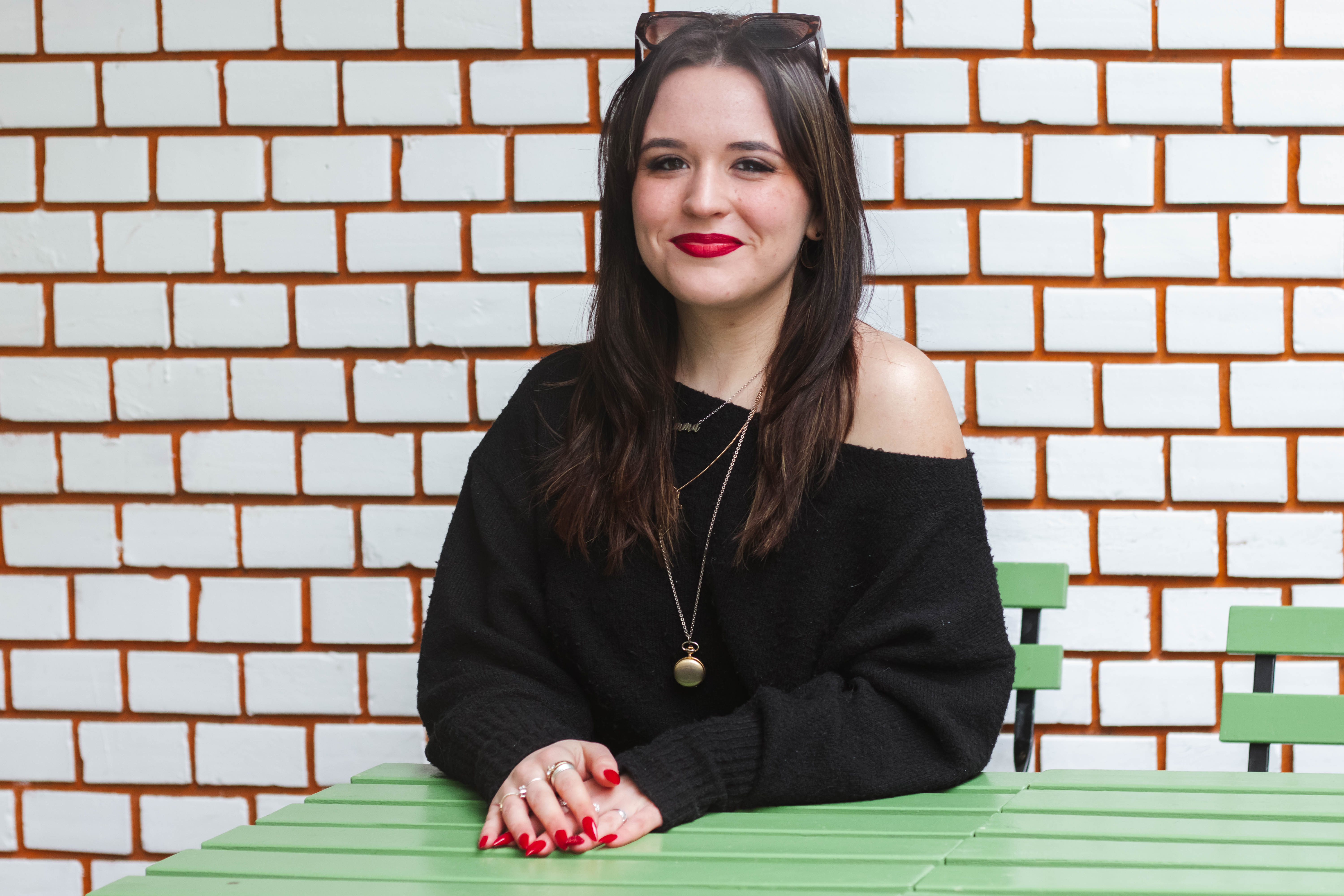
Throughout the history of PécsiBölcsész, the magazine has always focused on presenting the everyday lives of students in an authentic and diverse way. In the process of achieving this, we recently had a conversation with an exceptional member, Emma Máté, the magazine’s new editor-in-chief. Emma explained to us how she prepares online content, what criteria guide her in the selection of topics, and how she strives to make the magazine conventional yet youthful and innovative at the same time. In our interview, we get a glimpse behind the scenes and learn what motivates her to keep our magazine enjoyable and relevant for all our readers.
When was the moment when you felt like “OK, I really must run for this office”?
I felt from the very beginning that I had to run for this office. Of course, I thought over the decision thoroughly and asked my friends for their opinion on whether they consider me right for this role. However, deep down, I always had a feeling that I would be suitable for it. I had wanted to be a journalist for a long time and had always been strongly attracted to the profession. Although I eventually gave up on this dream as a long-term goal, I thought that within the framework of PécsiBölcsész Magazin I would have the opportunity to experience what it is like to work in journalism and, in the short term, somewhat fulfil a part of my dream. That is why it was no question that I would run for this post.
How are you contributing, either personally or professionally, to the magazine?
I feel that, primarily, I contribute a lot on a personal level, which of course also has an impact on the professional operation.
My greatest strength is my motivation.
I am convinced that this was one of the main reasons why I ultimately won the office, as I am extremely dedicated to this field. I believe that an organisation like this cannot function effectively without the right amount of motivation. I currently coordinate the work of nearly thirty people on the editorial staff, and if someone lacks the necessary enthusiasm and commitment, they are not able to keep up with the pace of the team or contribute meaningfully to the joint effort.
How would you describe your own editorial thinking? What are the principles you apply when choosing a topic or deciding on material?
In the selection of topics, I try to stick to conventions to a certain extent, as there are ideas that are worth following. At the same time, it is important for me to include new elements, especially topics that I feel have been pushed into the background so far, even though they deserve greater emphasis. A specific goal of mine is to have more articles on serious matters published in the magazine. I strive to ensure that the topics are diverse, so that every reader can find something that arouses their interest and that they would like to read about.
What are the topics that are really close to your heart, and that you would like to see more often in the magazine?
One such area – which I have already begun to boost – is art. I have a particularly deep interest in visual arts, but I am fundamentally intrigued by all branches of fine art – which is no coincidence, since I am studying art history. I would like to incorporate this area more consciously and emphatically into the magazine’s content. Another area that is also essential to me is fashion. So far, only small steps have been taken in this field, but I definitely want to give it more space in the future. In addition, it remains important to me that the more serious topics mentioned beforehand are also published prominently.

What do you think makes a student magazine truly “living and breathing” and relevant to students? What makes students feel that it is all about them?
I think it is crucial to keep in mind that the university itself is a defining part of students’ lives. When someone enters university, for a while almost everything revolves around it: what their major is, what their classmates are like, the courses, and life at the university itself. That is why I consider it essential that the magazine prominently features topics and events related to university life that are of genuine interest to students. At the same time, I feel like including topics that are not directly related to the university is just as important. After all, even though this is a university-based magazine, we are not simply students but also members of the youth. Our everyday lives are not exclusively organised around the university; therefore, I believe that the magazine’s task is to address readers in a youthful way, from the perspective of our own generation.
What new topics are you considering that you think would better showcase the diversity of the Faculty?
I would definitely like to place greater emphasis on translated articles, a process that has already begun. I do not want the magazine’s content to become trivial or feature articles that people might not even read. Thus, I believe that it is necessary to consult with the scientific and student welfare rapporteur to conduct a survey among students to find out what subjects they are actually interested in. This could significantly contribute to making the magazine’s content more diverse and relevant to readers.
How important do you consider online presence and new content formats to be? Is there any area in which you would particularly like to experiment?
I consider online presence to be extremely important, as the magazine itself is published in digital form. Of course, it is very exciting to produce the printed edition for Hungarian freshmen every year, so I would definitely like to experiment with that. However, since we only publish a physical copy once a year, it is essential that our online platform is transparent, well structured, and easy to use. We regularly share newly published articles and announcements on our social media platforms, so all of our work is readily available in the online space. Our online presence is not only the basis of the magazine’s operation but also a natural part of our everyday lives: this is where we communicate with each other, and we are constantly active on these platforms.
How would you like to address those readers who have not really read or followed the magazine so far?
In my opinion, the poll will provide substantial help in developing the magazine. Some readers might not follow our content regularly because the topics we have covered so far (such as sports, cooking, and TV series) have not caught their interest. A comprehensive survey will give us a more accurate picture of what topics the majority of students would like to see, and we can use this information to consciously plan the content for the upcoming months. With the launch of our new website, we are already reaching a wider audience, but there is still plenty of room for improvement in this area. Our goal is to further refine the methods we use to engage readers and appeal to them more effectively.
This interview clearly demonstrated that the work of an editor-in-chief consists of much more than just editing articles or selecting topics: people, motivation, and commitment to the community are just as important. Emma’s attitude and enthusiasm enable PécsiBölcsész Magazin to constantly renew itself while preserving university conventions. Online content, diverse topics, and consideration of reader needs all serve to make the magazine interesting, relevant, and inspiring material for all students.
Photos: Barbara Péter